
NEWS
How to Choose a Construction Site Security Company in the UK
The number of companies offering construction site security in the UK has grown considerably in recent years. CCTV towers, monitoring contracts, and mobile security systems are no longer niche; they’re mainstream, and the market reflects that. Which means the quality gap between providers has also widened. Choosing the wrong supplier doesn’t just mean a disappointing service; it can mean a gap in your security that results in theft, an insurance claim that gets declined, or a main contractor audit that raises serious questions about your site management.
This guide gives you a clear framework for evaluating and selecting a construction site security company, the accreditations that matter, the questions worth asking, and the warning signs to watch for.
Start with accreditation
Accreditation is the baseline filter. It tells you that a provider has been independently assessed against a recognised standard and that their systems, processes, and people meet a defined minimum. The key schemes in the UK security industry are:
NSI (National Security Inspectorate)
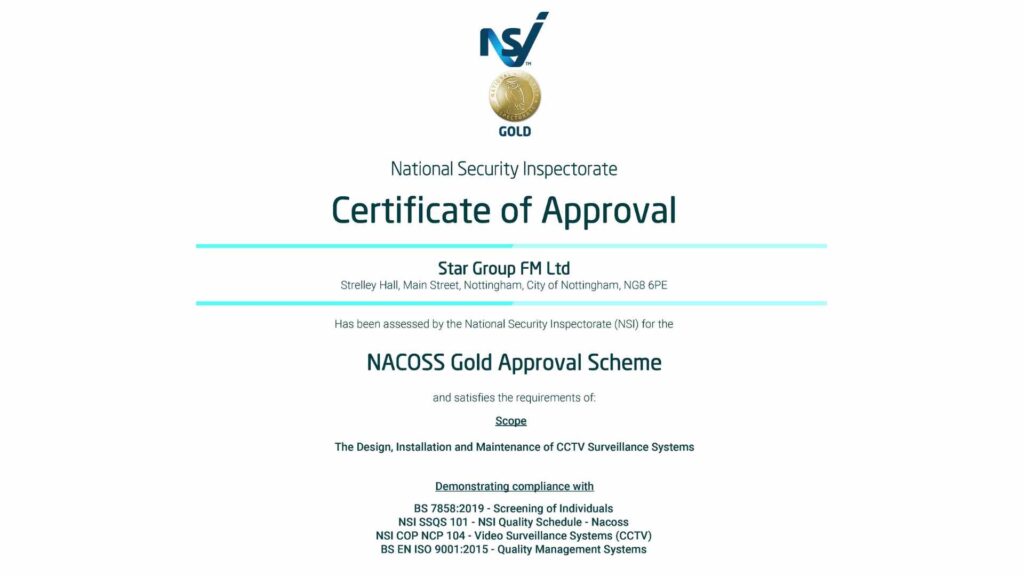
NSI is the leading independent approval body for the UK security industry. An NSI Gold or Silver approval for CCTV installation and monitoring means the company has been audited against BS EN 50132 (CCTV systems) and the associated monitoring standards. For construction site CCTV, NSI approval is the most meaningful accreditation to look for.
SIA (Security Industry Authority)
The SIA licenses individual security operatives, guards, CCTV operators, and keyholders in the UK. Any company providing manned guarding or staffed monitoring must hold the appropriate SIA licences. Ask to see them.
The monitoring question, ask it first
Before anything else, establish exactly what “monitored” means in the context of a quote you’ve received. This single question filters out a significant proportion of the market.
There are three tiers of what gets called monitoring:
- Recording only, footage is stored and can be reviewed after an incident. No active oversight. No response.
- Automated alert forwarding: motion triggers an automated notification to a keyholder or app. No human review of the footage in real time.
- 24/7 staffed ARC monitoring, a human operator reviews alerts as they happen, issues audio challenges, contacts keyholders, and escalates verified incidents to police.
Only option 3 constitutes genuine active monitoring. Options 1 and 2 are frequently described as “monitoring” in marketing materials. Ask specifically: Is my site monitored by a staffed Control Room, 24 hours a day, seven days a week, 365 days a year? If the answer is anything other than a clear yes, probe further.
Response times, get them in writing
Detection is only useful if something happens as a result. Ask every provider you’re evaluating to provide their average alert-to-response time, the time from a detection event triggering to a monitoring operator reviewing the alert and taking action.
Industry best practice is under 60 seconds for alert review. Ask whether this is guaranteed contractually or whether it’s an average that masks significant variation at peak times.
Also, clarify the response cascade: what happens after the operator reviews an alert? In what order are keyholders contacted? Under what circumstances is the police called? How is the incident documented and reported to you?

Equipment specification: what to look for
Not all CCTV towers are built to the same standard. When evaluating equipment, ask about:
- Camera resolution, 4MP minimum for identification-quality footage; higher is better
- AI motion detection, distinguishes humans from animals and environmental movement; critical for reducing false alarm rates
- Night vision, IR illumination range and whether thermal imaging is available
- Power source, solar/battery hybrid, eliminates generator dependency and ongoing fuel cost
- Siren specification, 113dB is the benchmark for effective audio deterrence
- Live audio challenge, can the monitoring operator speak through the tower in real time?
- Anti-tip stability, suitable for all terrain types without groundworks
Ask to see a technical specification sheet for the exact unit that will be deployed on your site, not a brochure for the range.
Redeployment and contract flexibility
A construction site is not a static environment. Phases change, the footprint shifts, and the risk profile evolves throughout the project. Your security contract needs to reflect that.
Key questions:
- Is redeployment included in the contract price, or charged as an additional visit?
- Can the number of units be scaled up or down as the project requires?
- What is the minimum contract term, and what are the exit conditions?
- What notice is required to add, remove, or reposition a unit?
A provider who offers genuine flexibility, redeployment included, scalable units, and reasonable contract terms is one that understands how construction sites actually work.
References and case studies
Ask for two or three references from comparable projects, similar in size, type, and duration to your own. A credible provider will have no hesitation in providing them. Ask specifically about:
- How quickly the system was deployed at mobilisation
- Whether the monitoring and response met expectations
- How the provider handled any incidents that occurred
- The quality of incident reporting and documentation

Red flags to watch for
- Vague answers about monitoring, if they can’t tell you clearly who monitors, when, and how, the answer is probably “nobody”
- No accreditation, NSI or SSAIB certification should be producible immediately on request
- Locked-in long contracts with no redeployment flexibility
- Generic risk assessments that aren’t tailored to your specific site
- No written SLA on response times
- Reluctance to provide references from comparable projects
How StarFM Group measures up
StarFM Group works with main contractors across the UK, including United Living, Hill Group, and Ground Control. Our rapid deployment CCTV, mobile lighting, and fire safety systems are installed by qualified engineers and supported by 24/7 monitored ARC contracts. We’re transparent about our accreditations, our response times, and our pricing.
to request a full specification and references for your next project.