
NEWS
How Construction Site Theft Affects Your Project Programme
When a construction site theft is discussed in financial terms, the conversation usually starts and ends with the value of what was taken. A telehandler worth £45,000. Tools worth £8,000. Copper cable worth £12,000. Those are the numbers that appear on the police report and the insurance claim, and they are real costs, but they are rarely the highest cost.
The highest cost is almost always the programme.
For a main contractor running a fixed-price NEC4 contract, a single significant theft can trigger a cascade of delays that is disproportionate to the value of what was stolen. Understanding that cascade, and factoring it into how you specify security, is the difference between treating security as a grudge purchase and treating it as programme protection.
The cascade effect of a single theft incident
Walk through what actually happens in the 72 hours after a theft is discovered on site.
Day 1, Discovery and assessment: The theft is discovered when operatives arrive on site, or, in the best case, flagged overnight by a monitoring system. The site manager assesses what has been taken, secures the affected area, and notifies the principal contractor and the police. If the stolen item is a plant, the work it was supporting stops immediately. If it’s materials, copper cable, rebar, or structural steel, the trades that depend on those materials stop.
Day 2, Sourcing and logistics: The replacement process begins. For a plant, this means contacting hire companies, confirming availability, and arranging delivery. Lead times on specialist plant routinely run to several days; for purchased machinery, weeks. For materials, it means reordering from the supply chain, which on a live project may mean cutting the queue or paying a premium for fast delivery.
Day 3 onwards: Programme reassessment. By this point, it is clear that the theft has cost more than a day. Dependent trades have been stood down or redeployed. Concrete pours have been rescheduled. Subcontractors have remobilised elsewhere. The ripple effect through the programme is being calculated, and the number is rarely comfortable.
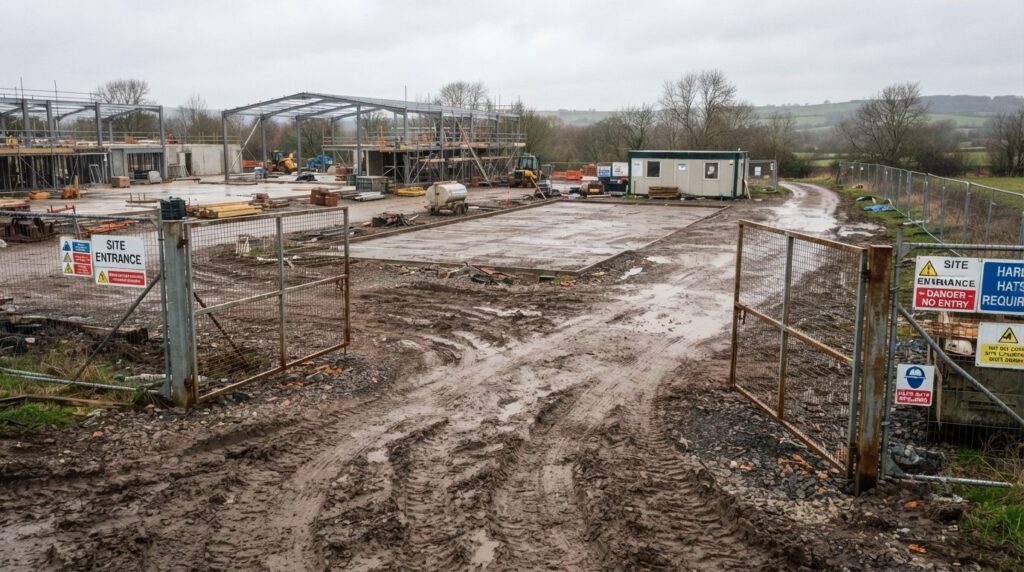
The specific programme risks by theft type
Plant and machinery theft
The most disruptive. A stolen excavator, telehandler, or dumper removes a critical resource from the programme instantly. If the machine was on the critical path, and on most active sites, the plant is, every day without a replacement is a day of programme slip. Hire availability in the UK market fluctuates; assuming you can get a like-for-like replacement the next morning is optimistic.
Materials theft
Copper cable, rebar, and structural steel are the most commonly targeted materials. The programme impact depends on how far through the supply chain the replacement needs to travel, a locally held stock item might be replaced within 24 hours; a specified product that needs to come from a mill or a distant warehouse might take weeks.
Tools and equipment
Individual tool theft may not halt the programme on its own, but the cumulative effect of repeated tool theft, which is common on sites that have been identified as unprotected, can significantly reduce productivity as trades work without their full kit while replacements are sourced.
Fuel
Often underestimated. A generator or plant tank siphoned overnight can halt all powered work on site from first thing in the morning. On a remote site without a nearby fuel supplier, the delay can run to half a day or more.

How security specification changes the programme risk
The argument for investing in site security is not just about recovering the cost of stolen items through insurance. It is about protecting the programme, and on a fixed-price contract, programme delay is the contractor’s problem, not the client’s.
A monitored CCTV system that detects and responds to an intrusion in real time changes the outcome. Not every attempted theft is prevented, but the deterrent effect of visible, active monitoring reduces the frequency significantly, and early detection limits the extent of any theft that does occur. A thief who triggers an audio challenge and sees police called with verified footage within minutes takes far less than one who has two hours to work undisturbed.
The cost of a rapid deployment CCTV system monitored 24/7 across a 12-month project is a fraction of the programme cost of a single significant theft incident. Put in those terms, the investment case is straightforward.
Documenting security for NEC4 and contractual purposes
It is worth noting that under NEC4, the principal contractor’s obligations around site security are clear, and a theft incident that results from demonstrably inadequate security can complicate the contractual position considerably. Maintaining a documented security specification, CCTV coverage plan, monitoring contract, lighting plan, access control procedure, protects the contractor’s position both with the client and with the insurer.
How StarFM Group can help
Our rapid deployment CCTV systems, mobile lighting, and fire safety provision are designed to protect both assets and the programme. We work with main contractors across the UK, including United Living, Hill Group, and Ground Control, and can have a fully monitored system operational on your site the same day on most projects.
about protecting your programme as well as your assets.