
NEWS
How to Write an Effective Construction Site Security Plan
A site security plan is no longer a document that only the largest and most complex projects require. In 2026, main contractors across the UK are increasingly asking subcontractors and site managers to produce one as part of the pre-start documentation package, alongside the construction phase plan, the health and safety file, and the environmental management plan.
If you haven’t produced one before, or if your current approach is a generic template that gets changed only at the top, this guide explains what a proper site security plan looks like, what it needs to contain, and how to make it work as a live document rather than a filing cabinet entry.
What a site security plan is, and isn’t
A site security plan is a written document that sets out how a specific construction site will be protected against the security risks it faces, who is responsible for security decisions, what systems and measures are in place, how incidents are reported and responded to, and how the plan will be maintained and reviewed.
It is not a risk assessment, though it should reference one. It is not a method statement, though it may sit alongside one. And it is not a generic template, a plan that doesn’t name the site, the specific risks, the actual systems in place, and the real people responsible for each element of it is not a site security plan in any meaningful sense.
The core sections of a site security plan
1. Site details and scope
Name the site, the project, the principal contractor, and the dates the plan covers. Define the scope: does this plan cover the full construction phase, or is it phase-specific? Who is the responsible person for security on this project?
2. Threat assessment summary
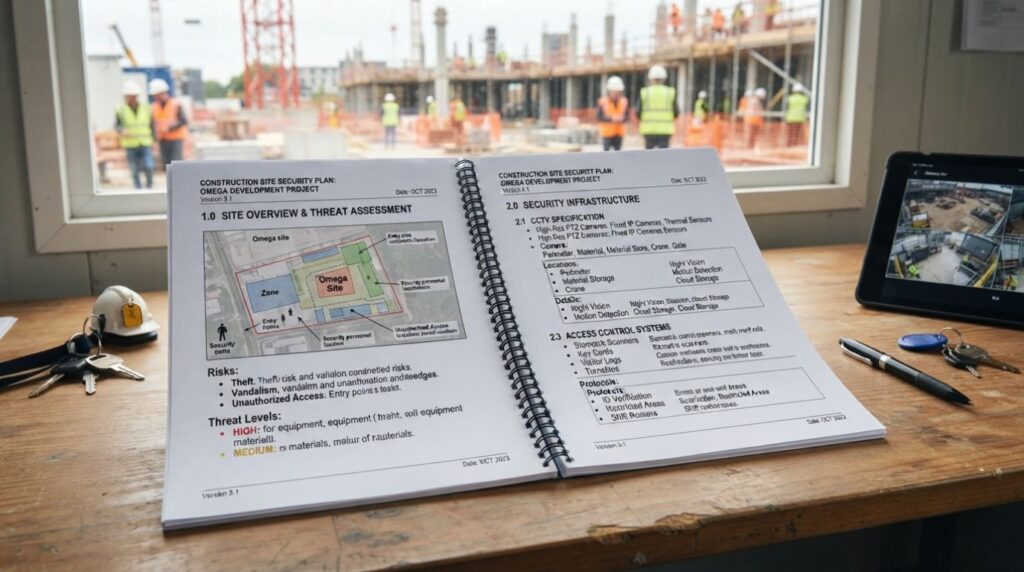
A brief summary of the specific threats identified in your security risk assessment. Not a generic list of construction site risks, the threats relevant to this site, based on its location, access, asset profile, and build phase. This section grounds the rest of the plan in the actual risk landscape rather than a theoretical one.
3. Perimeter and access control
How the site boundary is secured, where the access points are, how they are controlled, and what the procedure is for authorising and recording access. Include the hoarding and fencing specification, the gate locking standard, the signing-in procedure, and the induction process.
4. CCTV and monitoring specification
The CCTV provider, the number and position of units, the camera specification, and, critically, the monitoring arrangement. Is the system actively monitored 24/7 by a staffed ARC? What is the monitoring provider’s name and the SLA on response times? What is the escalation process when an alert is confirmed?
Include the coverage plan, a marked-up site plan showing exactly what each camera covers. This is what an insurer or main contractor auditor will want to see.
5. Lighting
The lighting specification, unit positions, power source, areas covered, and how the scheme will be reviewed as the site evolves through its phases.
6. Fire safety provision
A brief summary of the fire safety measures in place, cross-referencing the fire risk assessment. The security plan and the fire safety plan should be consistent, the same responsible person, the same emergency contact arrangements.
7. Incident reporting procedure
Who gets called, in what order, at what time of night. The keyholder list, the monitoring provider’s contact details, the police reference number process, and the site manager’s out-of-hours number. This section needs to be specific enough that anyone on the project can action it without additional guidance.
8. Review and update schedule
Define when the plan will be reviewed, at minimum at each project phase change, after any incident, and before any extended shutdown period. Name the person responsible for initiating each review and maintaining the document.
Making it a live document
The most common failure of site security plans is that they are written once, filed, and never looked at again. A plan that doesn’t reflect the current state of the site is worse than useless, it creates a false impression of control that doesn’t match reality.
Build in review triggers from the start. When the site layout changes significantly, the coverage plan needs updating. When a new subcontractor comes on site with their own plant, the asset profile needs updating. When the site manager goes on leave, the keyholder list needs updating.
A security plan that is maintained as a live document demonstrates to insurers, main contractors, and the HSE that security is being actively managed, not just documented once and forgotten.
How StarFM Group supports security documentation
Every StarFM Group installation comes with full written documentation, CCTV coverage plan, monitoring contract, and incident reporting records, that feeds directly into your site security plan. We can also assist with the security specification sections during the pre-start phase.
before your next mobilisation.