
NEWS
Why August Bank Holiday Is High-Risk for Construction Site Theft
For many UK construction sites, the August bank holiday is more than just a long weekend. From a security point of view, it creates one of the most vulnerable periods of the month – sometimes of the entire summer. Work slows down or stops, key staff are away, delivery schedules change, and sites may sit largely unattended for longer than usual. For criminal groups looking for the right moment to target plant, tools, fuel, cable, or materials, that combination is highly attractive.
The problem is not just the extra day. It is the wider pattern around it. Sites often wind down early on the Friday, may remain quiet over the full weekend and Monday, and can take time to restart properly on Tuesday morning. That creates an extended gap in activity and oversight. If the final pre-weekend checks are rushed or if the security setup is treated as “good enough,” the site can be left exposed for exactly the kind of period intruders are looking for.
This is why August bank holiday security deserves deliberate planning rather than a routine lock-up.
Why long weekends create different risks from normal closures
A standard overnight closure already creates a degree of vulnerability. However, overnight windows are relatively short, and legitimate activity restarts quickly the next day. A bank holiday weekend changes that equation significantly.
The first major difference is time. Intruders know they are often working against less immediate risk of interruption. If a site is not being monitored actively, they may assume they have hours rather than minutes. That can be the difference between a quick opportunist theft and a more organised removal of plant, fuel, or materials.
The second difference is site rhythm. Construction activity has patterns: neighbours, security staff, site management, nearby businesses, and passing workers all contribute to informal visibility. During a long bank holiday weekend, that rhythm drops away. Industrial estates are quieter. Nearby offices may be empty. Vehicle movement falls. Even in busy urban areas, a silent site over several days is much easier to assess and target.
The third difference is human response. Site managers, keyholders, and decision-makers may be on leave, travelling, or simply harder to reach. If a monitored system activates but the escalation list has not been updated, response quality drops exactly when it matters most.
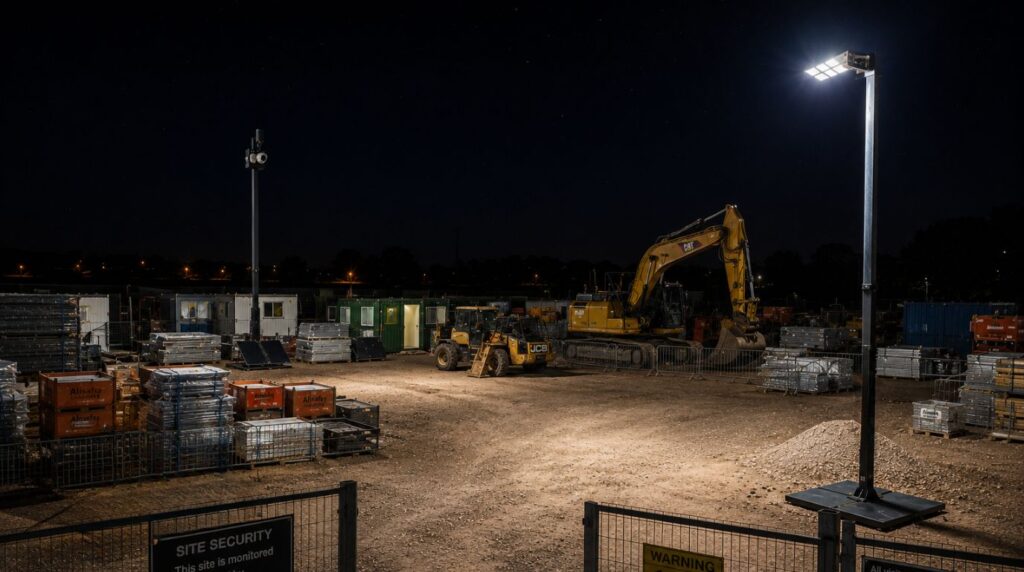
What criminals are most likely to target over a bank holiday
Bank holiday periods are rarely random from a theft point of view. Certain assets are consistently more attractive because they are valuable, portable, or commercially disruptive.
Plant and machinery
Excavators, dumpers, telehandlers, and smaller items of mobile plant remain top targets. Even where large machines are hard to remove quickly, attachments, smaller items of kit, and easily moved plant may still be highly vulnerable.
Fuel
Fuel theft becomes even more attractive over a long closure period because there is more time to work without interruption. A siphoned bowser or drained generator tank may not be discovered until the site tries to restart, meaning the operational impact hits at exactly the wrong moment.
Cable and metal
Temporary supply cable, copper pipe, and other metal-rich materials are common targets because they are both accessible and quickly saleable. Sites left quiet for several days are especially exposed if partially installed materials are already on site.
Tools and welfare areas
Cabins, stores, and welfare units can become soft targets if the focus has been placed only on the outer perimeter. A thief may not need to access the plant compound at all if they can get into a tool storage area quietly and leave with portable equipment.
Why “we’ve never had a problem before” is weak protection
One of the most common and most dangerous assumptions around bank holiday security is that a site with no theft history is a low-risk site. In reality, previous luck is not the same as protection.
A site can remain untouched for months because:
- it has not yet been noticed
- more attractive targets were available nearby
- local criminal activity has been low
- timing simply has not lined up
A bank holiday can change that. If the site has visible assets, weak closure routines, poor lighting, or limited monitoring, the risk level may rise sharply even if no previous incident has occurred.
What should be reviewed before the last person leaves
A proper bank holiday close-down should involve more than locking the gate. It should include a targeted review of the site’s most vulnerable assets and the systems protecting them.
1. Review the monitoring setup
If the site uses monitored CCTV, confirm that:
- monitoring remains active for the full closure period
- the correct keyholders are registered
- out-of-hours contact details are current
- there is a clear escalation path if the primary contact is unavailable
2. Recheck camera coverage
The site may have changed significantly since the CCTV layout was first planned. New materials may have arrived. Plant may have been repositioned. Blind spots may have opened up. Walk the site and confirm that the actual risk areas are still covered properly.
3. Prioritise the highest-value assets
Before closure, identify which assets would create the greatest loss or disruption if stolen. These usually include:
- plant compound contents
- fuel storage
- temporary power setup
- internal fit-out materials
- welfare/tool storage
Where possible, move assets into stronger protected areas rather than leaving them where they were last used.
4. Maintain lighting
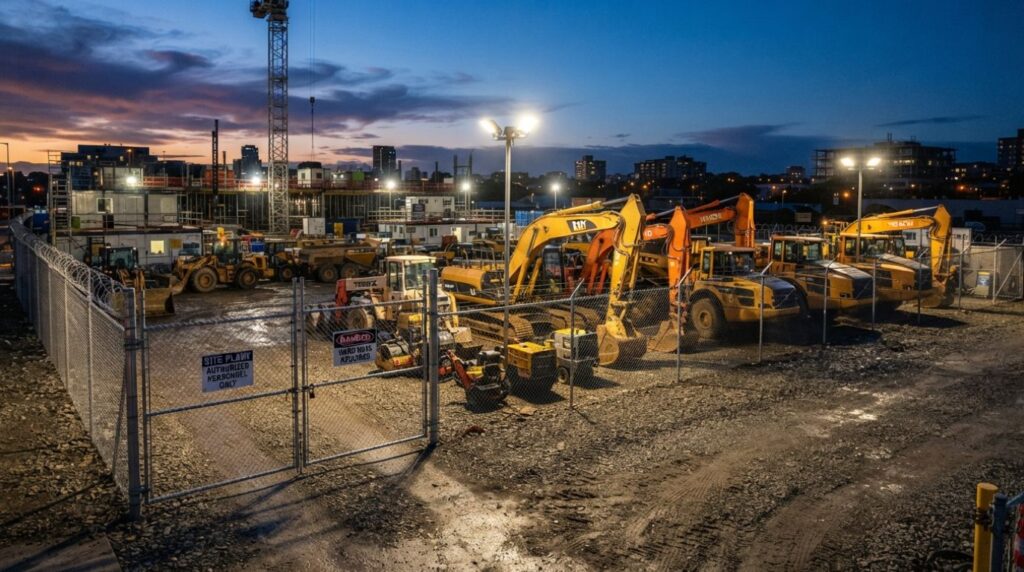
A surprisingly common mistake is reducing lighting over closure periods to save cost. That can be a false economy. Lighting is not only a deterrent, but it also improves the usefulness of the footage your cameras capture if an incident does occur.
A practical August bank holiday checklist
Use this as a final close-down checklist before the site goes quiet:
- Monitoring live for the entire closure period
- Keyholder list reviewed and updated
- High-value assets consolidated where possible
- Compound gates checked and secured
- Fuel and temporary power areas reviewed
- Welfare cabins and tool stores locked and checked
- Lighting operational in priority areas
- Return-to-site inspection planned for reopening
That final point matters. A proper restart inspection helps identify any attempted access, tampering, damage, or theft before work resumes and the programme moves on without a clear record.
Security during closures is really about continuity
The most useful way to think about bank holiday security is not just in terms of theft prevention. It is about continuity. A site that reopens cleanly on Tuesday morning, with no missing kit, no drained generator, no damaged access point, and no disruption to the programme, has protected much more than its physical assets. It has protected time, labour, delivery sequencing, and client confidence.
That is why closure security deserves more attention than it often gets.
How StarFM Group can help
Our rapid deployment CCTV, monitored security systems, and mobile lighting are designed to keep construction sites protected through the periods when they are most exposed – including long weekends, shutdowns, and extended unattended closures if you have a bank holiday or summer closure coming up, before the site goes quiet.